1. Government confirms zero-emission Paris goal to be enshrined in law

    March 15, 2016

    Energy Minister Andrea Leadsom says net zero Paris goal will be written into UK law following advice from the Committee on Climate Change in the autumn. The government has promised to enshrine a key Paris commitment to deliver a ‘net-zero’ emission economy into UK law, Energy Minister Andrea Leadsom told the House of Commons yesterday.

    Responding to calls by former Labour leader Ed Miliband for a new legislative goal in support of the Paris Agreement, Leadsom said the government is seeking to “build on the momentum of Paris” and will produce a plan for enshrining the net-zero emissions target into law later this year.

    The announcement means the UK’s legal target to reduce emissions will be tightened from its current goal of an 80 per cent reduction against 1990 levels by 2050 under the Climate Change Act to a net-zero target by the second half of the century, bringing it in line with international pledges made in Paris in December.

    “The government believes that we will need to take the step of enshrining the Paris goal for net zero emissions in UK law,” Leadsom told MPs. “The question is not whether but how we do it. There is an important set of questions to be answered before we do. The Committee on Climate Change is looking at the implications of the commitments in Paris and has said it will report in the Autumn. We will want to consider carefully the recommendations of the Committee.”

    The UK is already bound by the Climate Change Act (CCA) to reduce its emissions by 80 per cent by 2050, based on a 1990 baseline. However, a law requiring the UK to reduce its emissions to net zero represents a substantial increase in ambition, effectively mandating the decarbonisation of hard-to-reach sectors of the economy such as agriculture, heat and transportation.

    The decision comes in response to a key amendment tabled by Miliband, which called for the Paris target to be added to UK law via the Energy Bill which is currently making its way through Parliament. The amendment won cross-party backing from MPs and follows months of campaigning from Miliband for the government to enshrine a higher emissions target into UK law.

    Miliband welcomed Leadsom’s remarks and urged other countries to follow the UK’s lead. “It is the right thing to do because the science demands it, it makes economic sense and will build momentum in the fight against climate change,” he said. “It is essential we build on the success of the Paris agreement and do not squander it and I hope other countries will no follow the example of the UK.”

    Source: Business Green

    http://www.businessgreen.com/bg/news/2450973/government-confirms-zero-emission-paris-goal-to-be-enshrined-in-law


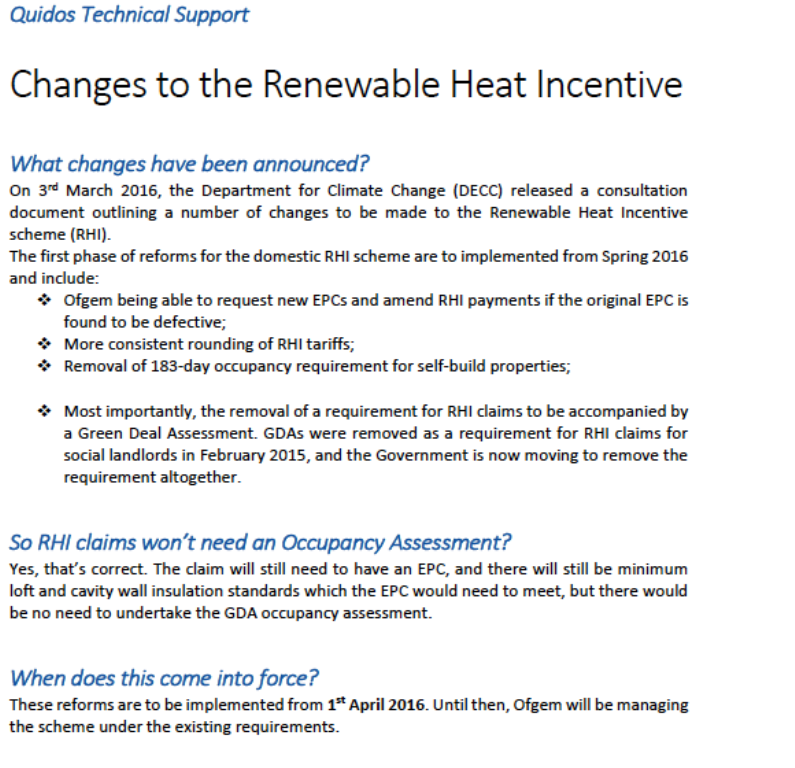
  2. Changes to Renewable Heat Incentive

    March 12, 2016

    rhi change  large
    (with thanks to Quidos Technical Support)


  3. Stop the UK government killing off the UK solar industry

    September 1, 2015

    Stop the UK government killing off the UK solar industry

     Don’t kill off the UK solar industry.

    Please reverse any plans to cut subsidies to solar power in the UK, this will harm UK jobs and be devastating for our environment.

    Why is this important?

    The Dept for Energy and Climate Change has just unveiled sweeping plans to slash subsidies to solar power. They are proposing measures that include cutting aid to small-scale solar power installations, and ending subsidies for roof-top panels earlier than expected. They are also thinking of reviewing the feed-in tariff.

    This is a hugely short sighted move by the government and is devastating for Britain’s solar sector which employs over 35,000 people. The Secretary of State herself has stated that the total cost this year of the solar RO was just £3 per household on energy bills. Ending support for solar power makes no sense at all. The energy market currently has a wide range of subsidies and tax allowances in place, across all the technologies – renewables, nuclear and gas – and not all of these are transparent when it comes to the consumer.

    They have made these announcements after the House of Commons has risen for the summer recess so proper scrutiny in Parliament will now not be possible until after the consultation deadline.

    The Welsh government is already concerned, a spokesperson said the plans have the “potential to put jobs and investment under threat by reducing subsidies to projects already in the pipeline”.

    The government is deliberately over-exaggerating the impact of renewable energy on bills and the timing of this move on solar power could not be worse as it is nearly subsidy free.

    “Cutting the subsidies now will see businesses go bust and investment dry up. Jobs will go and emissions will stay higher at a time when policies and funding should be in place to ensure quite the opposite,” said Daisy Sands, head of the energy campaign at Greenpeace.

    Ray Noble, owner, Solar BIPV Ltd and Solar Power Portal outstanding achievement award winner has commented:
    “The decision to stop supporting the fastest deploying energy generation technology seems like madness to me. Especially when you consider that we are short of electricity, that solar has the biggest support of the the population; yet at the same time still giving 2 ROCs to other technologies that are creating the largest drain on the budget. Seems like winners are not liked and losers are preferred!

    “Combined with the cuts to wind subsidies, it looks like the government is gearing up for a full frontal attack on the renewable energy sector in the autumn while still handing out billion-pound tax breaks for oil and gas industry … It’s no good David Cameron saying how important the climate talks in Paris are, if the chancellor simultaneously weakens any shred of credibility of a claim to the UK’s low carbon leadership.”

    Please sign the petition now to help save jobs in the UK and support our commitment tackling climate change.    Go to:

    https://you.38degrees.org.uk/petitions/stop-the-uk-government-killing-off-the-uk-solar-industry


  4. Changes to green home improvement policies announced today

    July 23, 2015

    23 July 2015   by DECC

    The Secretary of State today announced that there will be no further funding to the Green Deal Finance Company, in a move to protect taxpayers.

    What does this mean for the future of the Green Deal?

    • In light of low take-up and concerns about industry standards there will be no further funding to the Green Deal Finance Company.
    • We will also stop any future funding releases of the Green Deal Home Improvement Fund.
    • This decision has no impact on existing Green Deal Finance Plans or existing Green Deal Home Improvement Fund applications and vouchers.

    What does today’s announcement mean for the Green Deal Finance Company (GDFC) and new Green Deal finance plans?

    • Green Deal finance plans are offered by approved providers who access a line of credit from the Green Deal Finance Company (GDFC). It is for the GDFC to decide whether to close to new finance plan applications and how to manage its own accounts.
    • The Green Deal’s Pay As You Save framework remains in place should other finance providers wish to come forward to enter the market.

    Why is the Government stopping its funding to the Green Deal Finance Company?

    • There will be no further to the Green Deal Finance Company because of low take-up and concerns about industry standards, ensuring taxpayers are protected.
    • The Government will work with the building industry and consumer groups on a new value-for-money approach.

    What does this announcement mean for consumers who already have Green Deal Finance Company plans?

    • Green Deal plans that are in place will continue as normal. There will be no impact on those who have already taken out plans.
    • Bill payers in properties with Green Deal Plans will still need to repay the loans and this money will continue to be collected via their electricity bill.

    What does this mean for the Home Improvement Fund?

    • We are stopping any future funding releases of the Green Deal Home Improvement Fund.
    • The latest ‘two measures’ offer will close to applications on 30 September 2015 or when the remaining £4 million of funding run out – whichever happens sooner.
    • Existing applications and vouchers will not be affected. Customers who want to redeem their voucher must complete the installation and submit the documents required to redeem their voucher to the Green Deal Home Improvement Fund Administrator on or before their voucher expiry date.

    What does this mean for the Green Deal Communities scheme?

    • Some Local Authorities still have funding available through Green Deal Communities. We will ensure this remaining funding is put to the best possible use and provides energy efficiency measures to benefit energy inefficient households across England.

    What does this mean for the future of ECO?

    • The ECO scheme will continue to run as normal until March 2017.
    • The future of the ECO scheme from 2017 onwards will be part of discussions around a new, better integrated policy for home energy efficiency

    Has the Green Deal been a total flop?

    • We’ve seen many success stories come out of Green Deal, but uptake has been lower than expected.
    • By the end of May 2015 there were nearly 15,600 Green Deal finance plans in progress, as well as over 27,000 energy efficiency measures installed in homes across England and Wales thanks to the Green Deal Home Improvement Fund. The total value of measures installed under the Home Improvement Fund is £114m.
    • But now it’s time for the building industry and consumer groups to work with us to make new value-for-money approach.

    How will people finance energy efficiency improvements?

    • We’re working with the building industry and consumer groups on a new value-for-money approach.
    • In the meantime, help is still available to those who need it most through the Energy Company Obligation (ECO) scheme.
    • More than 1 million homes have already benefitted from energy efficiency improvements – such as new boilers and insulation – through the ECO scheme.


  5. Amber Rudd: Climate Thatcherite promises green business boost

    May 11, 2015

    11 May 2015, by James Murray  , BusinessGreen

    Amber Rudd

    The sigh of relief from across the green business community was almost audible. With the bizarre and ultimately doomed appointment of climate sceptic Owen Paterson as Environment Secretary casting a long-shadow there was genuine concern David Cameron could use his unexpected majority to push action on climate change down the agenda with the appointment of a Secretary of State disinclined to take decarbonisation seriously. It is not as if he didn’t have plenty of ambitious ministers with minimal interest in climate change and hostility towards clean technologies to choose from.

    With one Tweet those fears, not to mention concerns the whole Department of Energy and Climate Change could be for the chop, were quelled. The appointment of Amber Rudd as the Energy and Climate Change Secretary is not simply just reward for an able and collegiate politician who has just increased her majority in a marginal seat, it is also great news for the green economy.

    Rudd has repeatedly put herself on record as warning that it is vital to take action on climate change, because of the “devastating impact it could have nationally and internationally” – a braver and more principled position than it should be for an ambitious Conservative politician given the manner in which this analysis is loudly rejected by some of her own colleagues.

    More importantly, she has a coherent sense of how environmental protection and climate action fits into modern Conservatism having previously identified herself as a “Thatcherite when it comes to climate change“, fond of quoting the Iron Lady’s famous assertion that “The core of Tory philosophy and for the case for protecting the environment are the same: No generation has a freehold on this earth. All we have is a life tenancy-with a full repairing lease”.

    As a former banker, city headhunter, and financial journalist she also understands instinctively that it is business and innovation that represents the last best hope of delivering steep cuts in global carbon emissions.

    Perhaps most importantly for green businesses, energy utilities and investors, Rudd has experience at DECC and a mandate to broadly continue with the current low carbon policy regime.

    Both the FT and Telegraph have already run articles arguing current policies are failing and calling for a fundamental overhaul of UK energy policy that dilutes the current focus on decarbonisation. Climate sceptic backbenchers will lap up this analysis and use it to demand a wider re-think. However, Tory sources this morning indicated the green economy should not worry too much about this analysis given the leadership’s commitment to long term emissions reductions remains solid. Rudd’s appointment underlines that commitment and means Cameron has passed the first test of whether he will stand by his pre-election commitment to continue to drive the decarbonisation of the British economy. Significant changes to the previous government’s electricity market reform programme and energy efficiency strategy would now come as a major surprise.

    It is important to remember Rudd’s appointment is anything but a sinecure and her commitment to tackling climate change is no guarantee this government will do so effectively. She faces numerous daunting challenges, several of which are made harder by a manifesto that lacked sufficient ambition on environmental issues and paints the Conservatives into a contradictory corner where they hymn the virtues of low cost decarbonisation while blocking low cost onshore wind farms and offering little in the way of new thinking on low cost energy efficiency measures.

    The Paris Summit is just the most high profile of a series of early tests, which also include the finalisation of long-running nuclear negotiations with EDF, the need to jump start the UK’s carbon capture programme, and imminent spending cuts at DECC. Crucial negotiations with the Treasury and Number 10 on the next wave of emissions targets and clean energy funding also present a major challenge. Rudd’s previous role as Parliamentary Private Secretary to the Chancellor may result in more collegiate relations with the Treasury than DECC has experienced over the past five years, although it may also fuel fears the Treasury brake on green economic progress will become even more pronounced.

    All these challenges will need to be overcome while coping with the impact an EU referendum will have on investor confidence and battling with a constant drumbeat of opposition to green policies from parts of the press and some of Rudd’s own colleagues.

    However, these valid concerns are for another day. For now green business leaders will welcome the fact that the new Secretary of State is as committed to tackling the threat presented by climate change as they are. Just as they will welcome the fact the Prime Minister wants an Energy and Climate Change Secretary who takes both topics seriously. The green business community and the Conservative leadership won’t always agree on how best to slash emissions, bolster UK climate security and enhance clean tech competitiveness, but Rudd’s appointment makes it clear the goal remains a shared one.

    Update:

    Those sighs of relief across the green economy have just turned to cheers with the news Eric Pickles has been replaced as Communities Secretary by Greg Clark, bringing an end to a period in which Pickles sought to undermine pretty much every environmental policy he had a hand in. In contrast, Clark has won plenty of plaudits from green groups in the past and is well regarded for his rational, evidence-based approach to policy-making. Add in confirmation Liz Truss is continuing at Defra and the climate sceptic wing of the party has been well and truly locked out of the main environmental briefs.

    As former Climate Change Minister Greg Barker wrote on Twitter this afternoon it is “shaping up to be a v progressive, pro green agenda reshuffle”.

    For those green business still smarting at the imminent halt to the UK’s onshore wind farm industry and the Tory manifesto’s limited ambition on energy efficiency the fact these policies will be enacted by Ministers who understand the urgency of the climate crisis may prove cold comfort. But there is little doubt Cameron has today exceeded the green communities’ expectations with a reshuffle that puts the Party’s modernisers in charge of the UK’s environmental policy framework.


  6. Problems mount as more homes without new-build EPCs come on the market

    May 7, 2015

    Written by: Rosalind Renshaw | May 7, 2015

    Are agents having trouble getting hold of EPCs for houses that were new-builds circa 2008 and are now being put up for sale?

    The EPC requirements for new homes are more onerous than for existing homes, requiring SAP calculations. However, it appears that several homes built or converted after April 2008 never had EPCs in the first place, posing problems for agents.

    The issue also highlights a more unlikely problem under the legislation as to what is a new home.

    Lee Russell, of Davis Tate in Woodley, Berkshire, says he has been tearing his hair out and approached Eye to highlight the matter.

    He has been receiving ongoing instructions on several homes without EPCs and has received conflicting advice.

    He turned to the Landmark EPC helpdesk after his EPC assessor said that the law requires all homes built from April 2008 to have a SAP EPC.

    The assessor’s advice was: “If this wasn’t done at the time of completion the legal requirement to produce a SAP EPC is not lifted and therefore must still be produced as the first EPC.”

    Landmark initially advised: “We must emphasise that we cannot provide advice on when a new building is no longer a new building. It is not something that is defined in Regulations. The Regulations do specify, however, that EPCs are required when a building is constructed, sold or let.

    “The requirements for newly constructed buildings to have an EPC on completion came into force on 6 April 2008; therefore, in the circumstances described, an EPC should have been provided for the properties.

    “If no EPC currently exists for the properties then one must now be provided if there is an intention to re-sell the properties.

    “It is unlikely that the detailed plans and specifications, that would have been available at the time of construction, are easily accessible now. It is also debatable whether properties which have been occupied for more than seven years (or constructed seven years ago) could be classified as a new dwelling.

    “In these circumstances the most sensible approach would be for the EPCs to be produced using RdSAP software.”

    The energy assessor then contacted the Quidos helpdesk, saying: “Properties built in 2008, 2009 and 2010 are now frequently going on the market and many did not have a Full SAP EPC carried out at the time of original completion/sale/let. As such agents are now approaching me to carry out an EPC to meet their legal obligation.

    “My stance has been what I was advised many years ago by BRE, namely that a full SAP EPC is still required as per regulations as these properties are ‘new builds’ regardless of whether they have been lived in or already sold before.

    “The fact that a full SAP EPC was not carried out does not remove the requirement to still have that done as the first EPC. Is this correct?”

    Quidos replied saying that this was correct.

    Landmark then said that their original response was incorrect. A full SAP EPC has to be carried out on all properties completed after April 6, 2008.

    Landmark’s new advice said: “We suggest that you follow the advice provided to you via your assessor from the accreditation schemes. This would be to first establish that there is no existing EPC by contacting the original builders/sellers and building control before commissioning your assessor to carry out an RdSAP report.

    “Otherwise you will have to commission a new SAP EPC for each property.”

    Davis Tate’s Lee Russell tells Eye that the developers of those original “new” homes now coming up for resale include well-known names. It is a mystery as to why these developers did not follow the letter of the law when it came to EPCs.

    But shouldn’t it be up to the vendors to provide the EPCs that they weren’t given in the first place?

    Russell said: “If you talk to sellers about EPCs, they look at you as though you have got two heads.

    “But in any case, I simply haven’t the time to chase up the original developers.

    “This problem is only going to get worse, as more and more of these properties come on to the market.”

    Eye would be interested to hear from other agents who find that homes built a few years ago have no EPCs. We would also be glad of advice from EPC firms.

  7. Tesla unveils batteries to power homes

    May 1, 2015

    From BBC News

    • 1 May 2015

    US electric carmaker Tesla Motors has unveiled batteries that can power homes and businesses as it attempts to expand beyond its vehicle business.

    Chief executive Elon Musk announced the firm would build batteries that store solar energy and serve as a back-up system for consumers during blackouts.

    The device would allow consumers to get off a power grid or bring energy to remote areas that are not on a grid.

    Tesla plans to start shipping the units to installers in the US by this summer.

    In a highly anticipated event near Los Angeles, Mr Musk said the move could help change the “entire energy infrastructure of the world”.


    “Tesla Energy is a critical step in this mission to enable zero emission power generation,” the company said in a statement.

    The rechargeable lithium-ion battery unit would be built using the same batteries Tesla produces for its electric vehicles, analysts said.

    The system is called Powerwall, and Tesla will sell the 7kWh unit for $3,000 (£1,954), while the 10kWh unit will retail for $3,500 (£2,275) to installers.

    Energy comparison firm USwitch estimates that one kWh can power two days of work on a laptop, a full washing machine cycle or be used to boil a kettle 10 times.

    Mr Musk said the company would partner with SolarCity to install the home batteries, but there would be more companies announced.

    Mr Musk is SolarCity’s chairman and largest shareholder.

    line

    Analysis: Richard Taylor, BBC News, San Francisco

    Tesla’s move into so-called “stationary storage” is a market with enormous growth potential: as the world slowly moves away from fossil fuels, it is seen as critical to a more widespread adoption of “clean” energy sources like solar and wind.

    There is also a strong commercial rationale for Elon Musk to leverage Tesla’s expertise in building highly-efficient car batteries and put them in a single unit in consumers’ residences.

    The business strategy is a bit like the battery itself: high impact, but a slow release which will really only reap significant benefits over time. But it comes with risks. Tesla may face a challenge getting the cost-saving message across to potential customers, especially with a significant $3,500 upfront cost.

    The carmaker also faces competition from battery-storage technology rivals with deep pockets such as GE (General Electric) and South Korea’s top chemical company, LG Chem. There is also a danger that this particular lithium ion battery could be superseded within a few years by other technology, like hydrogen fuel cells, which Tesla is not equipped to make.

    Still, these are risks Tesla is clearly prepared to take on. Its cars have won rave reviews, but precious few sales outside its California heartland. With a $5bn gigafactory not due to open until 2017, and only a single Tesla vehicle available to buy today, diversification of its product line into an area like this will be key to keeping investors happy.

    line

    The sales of battery storage systems for homes and businesses could yield as much as $4.5bn in revenue for Tesla, according to Deutsche Bank.

    The automaker reported fourth quarter earnings that missed market expectations in February, as it saw a loss of $107.6m on production and delivery issues.

    Friends of the Earth’s renewable energy campaigner Alasdair Cameron said having solar panels and a home battery in the future could become as common as central heating.

    “Just as the internet changed the way we use information so renewable sources, like wind and solar, are changing the way we make and use energy – and electricity storage is an important part of that change,” he said.

    “Cheaper and more efficient energy storage means individuals and businesses could save renewable energy until they need it, hugely reducing the need for climate-changing fossil fuels.”

    Colin Brown, director of engineering at the Institution of Mechanical Engineers said Tesla’s announcement is timely considering the push by governments to reduce emissions.

    “Without storage you’ve always got to have huge capacity just in case one of the peaks come through at a particular time – a very hot day when you need a lot of cooling, and so a lot of demand. With storage, you don’t have to have all of that massive production of energy,” he said.


  8. Renters and landlords to enjoy warmer properties and cheaper bills

    February 11, 2015

    Up to 1 million tenants renting from a private landlord can look forward to warmer homes that cost less to heat, under new government plans.

    Up to 1 million tenants renting from a private landlord can look forward to warmer homes that cost less to heat, under new government plans.

    This is welcome news for tenants, especially low-income and vulnerable households, many of whom are paying over the odds to heat their homes.

    From April 2018, landlords will be required by law to get their leakiest properties to an energy efficiency rating of at least Band “E”. Estimates suggest that on average the difference in a heating bill from the least energy efficient properties and those with an energy rating Band “E” is £880.

    Fuel poor households living in the least efficient privately-rented homes already need to spend on average around £1,000 more to keep warm compared to the average home.

    Secretary of State for Energy and Climate Change Edward Davey said:

    “These new laws will plug the gaps in draughty homes – helping households to keep warm and drive down bills.

    “Many of the poorest tenants will benefit and, with government support, landlords can improve their properties at no upfront cost.

    “It’s good news all round and yet another way we’re taking action to ensure that cold homes with bloated energy bills become a thing of the past.”

    Parliamentary Under Secretary of State Amber Rudd said:

    “One million homes are already warmer and cheaper to heat as a result of government policies, but we’re not stopping there.

    “These new regulations will drive bills down in some of the worst-insulated homes where up to 1 million tenants are paying too much to keep warm. It’s also good news for landlords, who can benefit from improved properties with the financial support of the Green Deal and other schemes, and a real boost to the industry.”

    Financial support is available through the Green Deal and Energy Company Obligation, which together have improved over 1 million homes in less than two years. This means landlords don’t necessarily have to foot the bill for installing new boilers and insulation measures to improve the energy efficiency of their properties – and landlords will only have to make improvements that are cost effective.

    What’s more tenants won’t have to wait for the April 2018 deadline to get their homes up to scratch. From April 2016 they will have the right to request consent for improvements to make their homes more comfortable, and easier and cheaper to keep warm, and the landlord cannot unreasonably refuse.

    The government is also drawing up plans for a £25 million fund to support the installation of first-time central heating systems in off-grid households. This is on top of an investment of over half a billion pounds over three years to get Britain’s homes warmer and leaking less energy. The government will also be announcing its Fuel Poverty Strategy soon.

    Additional Notes

    – This is the same for Non-Domestic Private rental properties

    – DECC are trying to push landlords into using the Green Deal and ECO for improving homes for this it seems.

    – There are exemptions for certain scenarios, it’s a fairly long list…

    – The new regulations apply from 1st April 2018 upon the granting of a new tenancy to a new tenant anda new tenancy to an existing tenant

    – Penalties for not being compliant may be up to a maximum of £5000 for Domestic Properties and £150,000 (!!) for Non-Domestic Properties


  9. Commercial EPC reminder

    January 15, 2014

    Commercial property owners without an Energy Performance Certificate (EPC) should obtain one as soon as possible or face the risk of having to obtain EPC’s under tougher criteria included in the Building Regulations update on the 1st April 2014.


    The planned changes will see current energy efficient benchmarks being raised. As a result, it will be harder for buildings without an EPC at present to achieve the better ratings if they do not undertake an EPC assessment before 1st April under the tighter criteria.


    Stephen Richards commented: “Buildings currently without an EPC certificate that are likely to seek to obtain one in the near future due to changes in tenants or ownership could find that the rating drops into the next band.”


    “Long term this is likely to have a significant impact on the property sector, as from April 2018 the new Energy Act will make it unlawful to rent out or sell a property which does not reach a minimum energy efficiency standard of E. Therefore any F and G rated assets are at risk.”


    Data produced by the Department of Energy and Climate Change estimates that around 18% of commercial property in the UK currently falls below the minimum EPC standard. This equates to approximately 600,000 assets.


    EPC certificate lasts for 10 years Building.


    Regulations were originally introduced in the 1980s and have evolved over many years to tighten up requirements. There are further updates planned for 2015.


  10. Government faces Brussels fines over energy efficiency failure

    December 13, 2013

    From www.building.co.uk

    10 December 2013 | By Vern Pitt

    UK could be hit with millions of pounds of fines after European Commission ruling on energy performance certificates

    The UK government could be hit with millions of pounds in fines due to its failure to enforce European rules on the use of energy efficiency certificates for buildings.

    In an initial ruling, the European Commission (EC) found the UK is not enforcing laws that require Energy Performance Certificates (EPCs) to be filed for all buildings when they are bought

    or sold.

    The requirement to produce EPCs for buildings designed to drive the market for sustainable buildings.

    The Brussels ruling, laid down last month, warned the UK government that it had to fully implement the law or else its case could be referred to the European Court of Justice, which is

    entitled to impose fines of millions of pounds.

    The government has two months to respond to the initial ruling.

    A spokesperson for the Department for Communities and Local Government (DCLG) said it was “working with [the Commission] to resolve the matter”.

    The government has already had to pay £5.7m to Landmark, the firm that runs the national database of EPC data, because of the low level of EPCs being completed.

    In September, housing minister Mark Prisk said: “As a result of low transaction volumes, due to the economic down turn under the last administration following the financial turmoil in 2008

    and 2009, and a number of enhancements to register services, the revenue from fees for entering documents onto the registers has not been sufficient to meet the full cost of operating the

    registers.”

    Andrew Warren, director of the Association for the Conservation of Energy, said the problem was the “slipshod” approach to enforcement of the law by the DCLG.

    He added: “There are at least six million transactions which should have involved an energy performance certificate, but have not done so.

    “But the communities department seems oblivious to reason. Perhaps a prosecution from the European Commission, followed by a stiff fine, will wake them up from their torpor?